Are Electric Kettles With Temperature Control Worth It?
Variable-temperature kettles promise better tea and coffee, but do they earn their keep? Here's what the extra money buys, and when a plain kettle is fine.

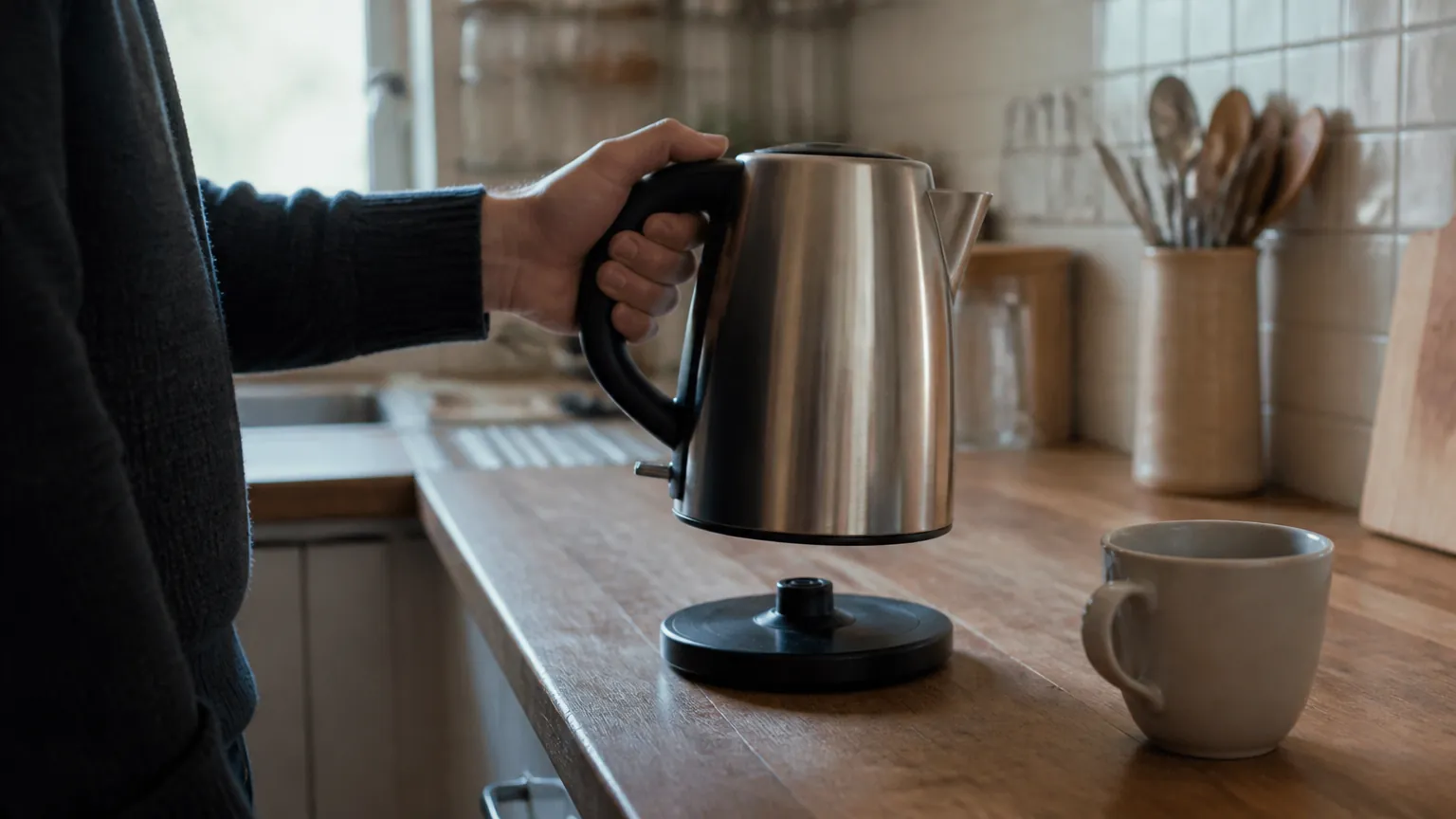
A plain electric kettle has one job: get water to a rolling boil. A temperature-control kettle lets you stop short of that, picking something like 70°C or 80°C instead of the full 100°C. The question is whether that extra control is worth paying for, or whether it's a clever way to charge more for something you already own. The honest answer depends on what you drink, how hard your water is, and how much you care about a few dollars a year on your power bill. Let's work through it in plain numbers.
What variable temperature is actually for
Boiling water is fine for black tea, instant coffee, and anything you're making with a tea bag you'll leave in for a few minutes. Where cooler water helps is with more delicate drinks. Green and white teas are commonly said to turn bitter when brewed with water straight off the boil, and many packets suggest somewhere around 70°C to 80°C (158°F to 176°F). Pour-over and French press coffee enthusiasts often aim for roughly 90°C to 96°C (194°F to 205°F), just below boiling, for a smoother result.
So a temperature dial is mostly a convenience for people who fuss over tea and coffee. If you've ever boiled a kettle, then stood there waiting a couple of minutes for it to cool before pouring over green tea, a kettle that stops at the right point saves you that guesswork. For everyone else, the feature will sit unused.
A note on baby formula
This one is different, because it's a safety matter rather than a taste preference. Public-health guidance in the US, the UK and Australia generally advises making up powdered infant formula with water that is hot enough to kill bacteria that can be present in the powder. That typically means water that has been boiled and then left to cool to no lower than 70°C (158°F) before mixing, with the made-up feed then cooled quickly to body temperature before feeding. Guidance varies slightly between countries and over time, so check your own national health service rather than relying on a kettle setting alone. A kettle with a 70°C option can make this easier, but boiling and letting it cool works too. Never feed a baby water that's still hot, and always test the temperature first.
Why your kettle's speed depends on where you live
If you've traveled between, say, the US and the UK or Australia, you may have noticed kettles boil faster in some countries. That's not your imagination. It comes down to mains voltage.
The UK and Australia run on roughly 230–240 volts. The US and Canada run on about 120 volts. A standard wall socket and plug can only safely carry so much current (amps), and power in watts is voltage multiplied by current. At 230 volts, a kettle can comfortably draw around 3,000 watts. At 120 volts, a typical kettle on an ordinary outlet is limited to around 1,500 watts, because pulling the same power would need double the current and would trip the circuit.
The practical result: a UK or Australian kettle can roughly halve the time to boil compared with a US one. To heat a liter of water from cold to boiling takes a fixed amount of energy, so a 3,000-watt kettle gets there in about half the time of a 1,500-watt one. This is also why many Americans find stovetop kettles or the microwave just as quick. It isn't a fault with US kettles; it's the voltage.
Keep-warm, filling, and what it costs to run
Many temperature-control kettles offer a keep-warm mode that holds the water at your chosen temperature for 20 to 60 minutes. It's genuinely handy if you make several cups over a morning. It also uses electricity for the whole time it's switched on, which is where the running cost sneaks in.
Let's put real numbers on it. The biggest energy cost is heating the water in the first place, and that's the same whether or not your kettle has a dial. Heating half a liter of water from 20°C to 100°C takes very roughly 0.05 kWh. Here's what one boil costs at typical rates:
| Country | Example rate per kWh | Cost of one 0.5 L boil (0.05 kWh) | Cost of 4 boils a day for a year |
|---|---|---|---|
| US | 17 US cents | about 0.85 cents | about $12.40 |
| UK | 25 pence | about 1.25p | about £18.25 |
| Australia | 30 Australian cents | about 1.5 cents | about A$21.90 |
Keep-warm adds on top of that. A kettle holding water warm might draw on the order of 100 watts on and off to top up the heat. Say it averages 100 watts for 30 minutes; that's 0.05 kWh, roughly the cost of another boil. Use keep-warm every day and you could add somewhere around $3 to $8 a year depending on your rate and habits. It's not alarming, but it's not free either, and it's easy to walk off and leave it running.
The bigger money-saver is simpler and applies to every kettle on earth: only fill what you need. Boiling a full kettle to make one mug wastes most of the energy. If you habitually boil a liter when you want 300 ml, you're roughly tripling the cost of every cup. Over a year of several cups a day, filling to the line you actually need can save more than any temperature feature will ever cost you. Most kettles mark a minimum fill; stay above it so the element stays covered, but don't overshoot.
Limescale in hard-water areas
If you live somewhere with hard water, you'll know it: a chalky white crust inside the kettle, flakes in your tea, and a longer boil as the deposit insulates the element. Large parts of the UK, much of Australia and many US regions have hard water. Soft-water areas have far less of a problem.
Limescale is mostly calcium carbonate, and a mild acid dissolves it. You don't need a special product.
- White vinegar: Fill the kettle with equal parts water and white vinegar, bring close to a boil, switch off, and leave for 20 to 30 minutes. Pour out, then boil a couple of kettles of fresh water to rinse away the taste before you use it.
- Citric acid: A tablespoon or two in a full kettle of hot water does the same job with less smell. Leave, rinse thoroughly, and you're done.
- How often: Monthly in a hard-water area, less often if your water is soft or you see no buildup.
- Prevention: Empty the kettle after use rather than leaving water standing, and consider a filter jug for the water you boil.
Descaling matters a little more with temperature-control kettles, because heavy scale can throw off the temperature sensor and make readings less accurate over time.
Features worth paying for
A basic kettle costs around $20 to $40. Temperature-control models typically run from around $50 to $120, with premium gooseneck pour-over kettles going higher. If you decide the control is worth it, here's where the money is well spent and where it isn't.
- Genuinely useful: A clear temperature readout, a few sensible preset buttons, and an accurate sensor. A removable, washable limescale filter in the spout. A wide opening so you can clean inside easily.
- Nice if you brew coffee: A gooseneck spout for slow, controlled pouring over coffee. A hold-at-temperature mode if you make several cups.
- Worth little to most people: App connectivity and voice control. They add cost and another thing to go wrong, and a dial does the job standing right next to it.
- Always check: That it has boil-dry protection and auto shut-off, and that the lid and handle stay cool enough to handle safely. Keep the cord and base away from the edge of the counter where a child could pull it.
Be honest with yourself about whether you'll use the settings. Manufacturers claim accuracy to within a degree or two, and that's plausible, but if you only drink black tea and coffee made with boiling water, you're paying extra for buttons you'll never press. If green tea, pour-over coffee or regular formula-making are part of your routine, the convenience is real and the running cost is small.
The short version
- Temperature control is for green and white tea, pour-over coffee, and following formula guidance (water at 70°C/158°F or above); for boiling-water drinks, a plain kettle is fine.
- UK and Australian kettles (around 3,000 W on 230–240 V) boil in roughly half the time of US ones (around 1,500 W on 120 V); that's the voltage, not a fault.
- Filling only what you need saves far more money than any feature; keep-warm adds a few dollars a year if you use it daily.
- In hard-water areas, descale monthly with white vinegar or citric acid, then rinse well; scale can skew the temperature sensor.
- Pay for a clear readout, accurate presets, a washable filter and solid safety cutoffs; skip app and voice features unless you really want them.
Emma Clarke
Home & Kitchen writer · Melbourne
Emma covers home and kitchen gadgets, from smart plugs to air fryers. She focuses on what things really cost to buy and run at home, and on the features that matter once the novelty wears off.
Keep reading
Air Fryer vs Oven: What Each Really Costs to Run
Air fryers get praised for saving money, but is that true for every meal? Here are the watts, the cooking times, and the cost per dish worked out in plain numbers.
What Is an OBD2 Scanner, and Do You Actually Need One?
That little socket under your dashboard can tell you why the check engine light is on. Here's what a scanner reads, what it costs, and who really benefits.
Hidden Car Features: What 'Coding' Can Unlock on VW, Audi and BMW
Many German cars ship with features switched off in software. Here is what coding through the OBD port can turn on, and the risks worth knowing first.
Comments
No comments yet. Share your experience or ask a question.