Heated Gloves and Socks: How Rechargeable Warmth Works
Heated gloves and socks promise all-day warmth from a small battery, but run times and heat levels vary a lot. Here is what actually keeps your hands warm.

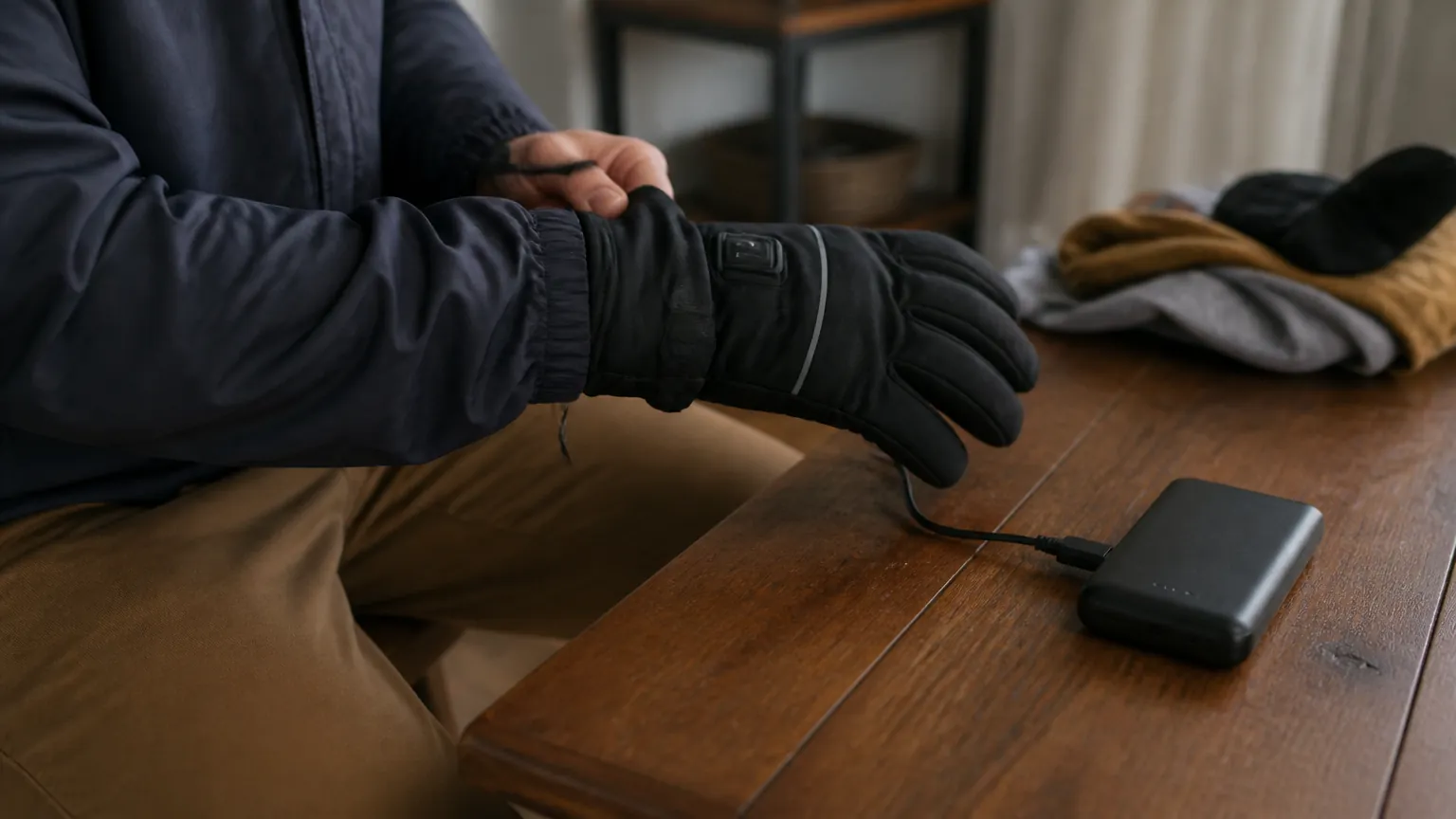
When a cold snap arrives and the discount emails start landing, heated gloves and socks look like an easy fix for numb fingers and cold toes. They are a genuinely useful piece of kit if you commute on a bike, work outdoors, or just lose feeling in your hands the moment the temperature drops. But the marketing tends to oversell run times and gloss over how the heat is actually delivered. This guide explains what rechargeable warmth really does, how long a charge lasts, what it costs to run, and where the safety limits are, so you can buy something that lasts the whole shift rather than fading after an hour.
How heated gloves and socks actually work
Inside a pair of heated gloves or socks are thin heating elements, usually fine carbon-fiber or metal wires, woven into the fabric near the fingers, the back of the hand, or across the top of the foot and toes. A small rechargeable battery clips into a pocket on the cuff or ankle and feeds low-voltage power to those elements. Most run on lithium-ion batteries rated somewhere between 7.4 volts and 12 volts, with capacities commonly from 2,000 to 5,000 milliamp-hours (mAh) per battery.
The warmth is radiant, not magic. The element heats up, the fabric spreads that heat, and the insulation around it keeps the heat close to your skin. That last point matters more than the wattage: a well-insulated glove with a modest heater will often feel warmer than a thin glove with a stronger one, because less heat escapes. Heated socks are usually lower-powered than gloves, because feet have less surface area to warm and the elements sit closer to the skin inside a boot.
One honest limitation: most heated gloves warm the back of the hand and the fingers from above, not the palm. That keeps the heater away from where you grip things, but it means your palms rely on the insulation rather than the element. For most people that is fine, but do not expect oven-glove heat across your whole hand.
Battery life: reading between the lines
This is where the claims and the reality part ways. Manufacturers usually quote run time at the lowest heat setting, in a warm room, with a fresh battery. In cold weather, on a higher setting, you will get considerably less. Lithium-ion batteries also lose capacity in the cold, which is exactly when you need them most.
As a rough guide, here is what to expect from a typical 2,500 mAh, 7.4-volt battery in each glove, with real-world results tending toward the lower end on a genuinely cold day:
| Heat setting | Approx. draw | Claimed run time | Realistic cold-weather run time |
|---|---|---|---|
| Low (around 38°C / 100°F) | 2 to 4 W | 6 to 8 hours | 4 to 6 hours |
| Medium (around 45°C / 113°F) | 5 to 7 W | 3 to 5 hours | 2.5 to 4 hours |
| High (around 55°C / 131°F) | 8 to 12 W | 2 to 2.5 hours | 1.5 to 2 hours |
The practical takeaway is simple: buy for the high setting, not the low one. If you need warmth for a four-hour shift and the gloves only manage two hours on high, you either need spare batteries or a product with a larger cell. Many people use high to warm up quickly, then drop to low or medium to maintain, which stretches a charge a long way.
A useful habit: charge the batteries the night before and store them indoors until you head out. Starting with a cold battery costs you run time before you have even switched the heat on.
What they cost to run
The running cost of heated wearables is tiny, because the batteries are small. The cost is almost entirely in recharging, and even that is pocket change. Take a pair of gloves with two 2,500 mAh, 7.4-volt batteries. Energy stored is roughly voltage times amp-hours: 7.4 V × 2.5 Ah = about 18.5 watt-hours per battery, so about 37 Wh for the pair, or 0.037 kWh.
At a US rate of about 17 cents per kWh, a full charge of both batteries costs roughly 0.037 × 0.17 = about $0.006, well under a cent. In the UK at about 25p per kWh that is roughly 0.9p. In Australia at around 30 Australian cents per kWh it is about 1.1 Australian cents. Even charging daily all winter, you are looking at cents over the season. Electricity prices differ by country and by tariff, so adjust the rate for where you live, but the conclusion holds: the electricity is negligible. The real cost is the gloves themselves and, eventually, replacement batteries.
What you will actually pay
- Heated gloves: commonly around $40 to $120 for everyday pairs, with heavier-duty work and motorcycle gloves running $120 to $250 or more.
- Heated socks: commonly around $30 to $90 a pair, usually sold with two batteries.
- Replacement batteries: often $15 to $40 each, and worth checking availability before you buy, since proprietary cells can be discontinued.
- Cheaper no-brand sets: under $30 exist, but run times and build quality are often disappointing, and the batteries are the first thing to fail.
Heat levels and safety
Most heated gloves and socks top out somewhere around 55°C (131°F) on their highest setting. That sounds modest, but prolonged skin contact with anything above roughly 44°C (111°F) can cause a low-temperature burn over time, especially if you cannot feel it properly. That is the real risk here, and it is worth taking seriously.
- Do not sleep in them. Heated socks are for activity, not bedtime. Falling asleep against a constant heat source is how low-temperature burns happen.
- Be careful if you have reduced sensation. People with diabetes, neuropathy, or circulation problems may not feel the fabric getting too warm. If that is you, check with a medical professional first and keep to low settings.
- Keep them away from young children. A child cannot reliably judge or report when something is too hot.
- Stop using any pair that smells hot, discolors, or has a damaged wire. A failing element is a fire risk, not a quirk.
Battery safety matters too. Lithium-ion cells should be charged with the supplied charger, kept away from water despite any "water-resistant" glove rating, and not left charging unattended overnight. If a battery swells, gets hot while charging, or will not hold a charge, stop using it and dispose of it through a proper battery-recycling point rather than household waste. The same care applies to any lithium battery, which is why we flag it in guides from garage jump starters to wearables. If you want a sense of how robust lithium battery packs can be when built well, our NOCO GB40 review covers a pocket jump starter that leans on the same chemistry, and our Oura Ring review looks at the flip side, where small batteries wear out faster than buyers expect.
Waterproofing and washing
Check the water-resistance rating before you trust a pair in the rain or snow. A rating of IPX4 means splash-resistant from any direction, not submersible. Remove the batteries before cleaning, and most gloves and socks are hand-wash only to protect the elements. A tumble dryer will usually wreck them, which is a different concern from the clothes-drying trade-offs we cover in our heat pump dryer vs vented running cost breakdown.
Who they suit, and who should think twice
Heated gloves earn their keep for motorcycle and bicycle commuters, dog walkers, anglers, photographers standing still in the cold, and anyone whose job keeps their hands exposed. Heated socks suit the same crowd plus skiers and people who simply cannot get their feet warm. If your hands go painfully cold on a short walk and no amount of normal gloves help, these are a reasonable thing to try.
Think twice if you need deep dexterity, as heated gloves are often bulky. If you need to operate a phone, tie knots, or handle small parts, thin heated liner gloves worn under a normal glove may suit you better than a thick heated pair. And if your cold hands are a new or sudden symptom rather than a lifelong nuisance, that is worth a conversation with a doctor rather than a gadget.
One more realistic note: these are comfort aids, not survival equipment. They extend how long you can stay comfortable in the cold, but a flat battery leaves you with an ordinary glove. Plan for that on long days outdoors.
The short version
- Heated gloves and socks use low-voltage lithium-ion batteries to warm the fingers and toes; insulation matters as much as wattage.
- Buy for the high heat setting: realistic cold-weather run time is often 1.5 to 2 hours on high, so consider spare batteries.
- Running costs are negligible, roughly a cent or less per full charge; the real spend is the gear and replacement batteries.
- Most top out near 55°C (131°F); never sleep in them, keep them from children, and take care if you have reduced sensation.
- Charge with the supplied charger, never leave a swelling or hot battery in use, and recycle old lithium cells properly.
Daniel Hart
Editor, Car & Garage · Columbus, Ohio
Daniel edits the Car & Garage section. He writes about the plug-in scanners, dash cams and chargers that help drivers understand their cars and avoid unnecessary repair bills, and he is clear about when a professional mechanic is still the right call.
Keep reading
Blink Outdoor 4 Review: Long Battery Life, Big Catches
An honest Blink Outdoor 4 review of the add-on camera: two-year battery claims, subscription catches, and whether the budget price is worth it.
Westinghouse Pressure Washer Review: The Honest Take
A compact, lightweight electric washer that covers most home jobs well, so long as you take its headline pressure numbers with a grain of salt.

Your First Cordless Drill: What the Volts and Amp-Hours Mean
Volts, amp-hours, brushless, combi or driver: a plain-English guide to picking a first cordless drill that matches the jobs you actually do.
Comments
No comments yet. Share your experience or ask a question.