Luggage Scale: Avoid Airline Overweight Fees
A handheld luggage scale costs about the price of one overweight bag fee, so here's what accuracy and features actually matter before you buy one.

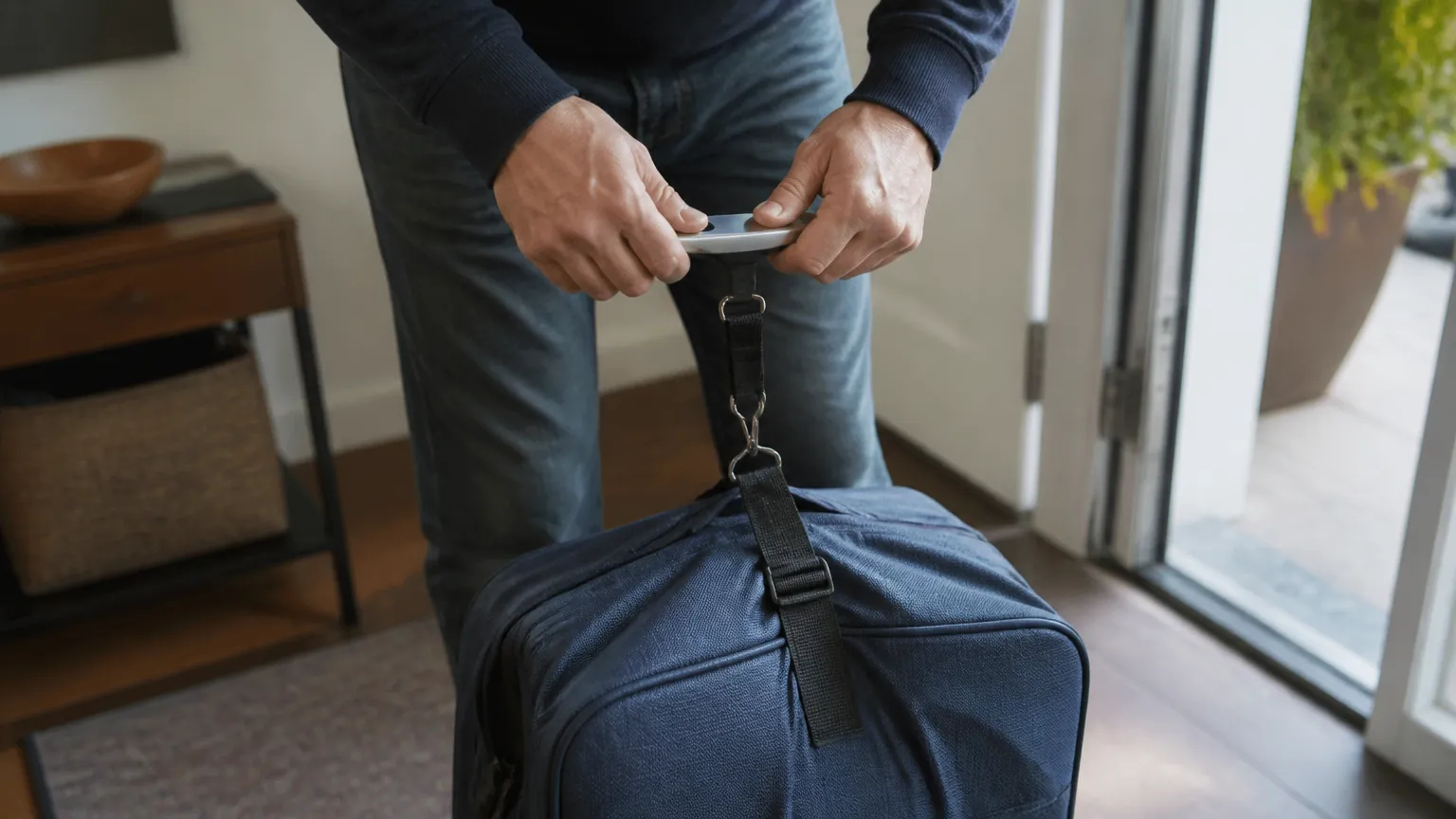
Overweight baggage fees are one of the few travel costs that feel entirely avoidable, and yet thousands of people pay them at the check-in desk every day. The fix is simple: a small luggage scale that lives in your suitcase and tells you the weight of your bag before you leave home. These devices cost very little, take up almost no space, and can spare you a scramble at the airport where you are repacking socks into your coat pockets while a queue builds behind you. This guide explains how a cheap handheld scale pays for itself, which numbers actually matter, and the handful of features worth paying attention to.
Why a luggage scale pays for itself
Airline overweight fees are deliberately steep because they are a captive sale. You are at the desk, your bag is already packed, and you have little choice but to pay. The exact charges vary by airline and route, but they are commonly in the range of $50 to $100 for a bag that tips over the limit, and long-haul carriers can charge more. Budget airlines are often the harshest, because a low headline fare is partly funded by baggage charges.
A handheld luggage scale typically costs around $10 to $25 (roughly £8 to £20, or A$15 to A$35). In other words, it pays for itself the very first time it stops you from going a kilogram over. If you travel even twice a year, the math is not close. You do not need an expensive model to get this benefit, which is why this is one of the few gadgets where the cheap option is genuinely fine for most people.
There is a second, quieter benefit: control. Weighing at home means you can decide what to leave out while you still have your whole wardrobe in front of you, rather than making panicked choices in a terminal. If you also worry about your bag going astray, that is a separate problem with a separate tool, and we cover it in our guide to luggage trackers and where they fall short.
How a handheld luggage scale works
Most portable luggage scales are a plastic or metal handle with a hook or a strap on one end and a small digital display. Inside is a strain-gauge load cell: a component that flexes very slightly under load and converts that flex into an electrical signal the display reads out as a weight. You loop the strap through your bag's handle, lift the bag clear of the floor, and the scale settles on a number.
The lifting part matters more than people expect. For an accurate reading, the bag has to hang freely and stop swinging. A bag that is resting partly on the floor, or still rocking, will give a reading that is too low or that jumps around. Most scales "lock" the figure once the load is stable, holding it on screen so you can set the bag down and still read it.
Mechanical versus digital
You can still buy spring-dial mechanical scales with no battery. They are robust and never go flat, but they are harder to read precisely and tend to be less accurate. The overwhelming majority of luggage scales sold now are digital, powered by a coin cell (often a CR2032) or a single AAA. Battery life is not something to worry about: these scales draw power only for the few seconds they are switched on, so a battery commonly lasts for years of occasional use.
What accuracy actually matters
Here is the honest version: you do not need laboratory precision. Airline limits are generous enough that being accurate to within about 100 grams (a quarter of a pound) is plenty. A typical checked-bag allowance is 23 kg (about 50 lb), and a cabin-bag limit is often 7 to 10 kg. If your scale is off by 50 to 100 grams, it changes nothing about whether you clear those thresholds.
What you want is not extreme accuracy but consistency and a sensible safety margin. Most handheld scales claim accuracy of around 10 to 50 grams, and manufacturers typically rate them for a maximum load of 40 kg or 50 kg (about 88 to 110 lb). That ceiling is well above any sane bag weight, so it is rarely a limiting factor.
A simple way to sanity-check a new scale at home: weigh something of known weight. A sealed bag of sugar or flour is usually marked as exactly 1 kg or 2 lb. Hang it, read the figure, and you will know within seconds whether your scale is trustworthy. If it reads 1.0 kg for a 1 kg bag, you are done worrying.
Give yourself a buffer
Whatever your scale says, aim to come in a little under the airline limit rather than right on it. Check-in scales at the airport are the ones that count, and they are not all calibrated to the same standard. Leaving a margin of 0.5 to 1 kg protects you against both small differences between scales and the paperback or bottle of water you shove in at the last minute.
Features worth having, and ones you can ignore
Luggage scales are simple, but a few features make real differences in use. Here is what is worth caring about:
- A clear backlit display. You often weigh bags in a dim hallway or hotel room at an awkward hour. A lit screen you can read at arm's length is genuinely useful.
- Unit switching. Being able to toggle between kilograms and pounds matters if you fly between countries that use different systems. Most airlines quote limits in kg, but US domestic allowances are often in pounds.
- An auto-lock or hold function. This freezes the reading once the bag is steady, so you can set it down before checking the number. Almost all do this, but confirm it.
- A strap rather than a bare hook. A strap distributes the load and is kinder on your fingers and on the bag handle, especially with a heavy case.
- Auto power-off. Saves the battery if you forget to switch it off, which you will.
Features you can safely ignore include Bluetooth connectivity to a phone app, which adds cost and a pairing step for a number you can already read on the screen, and "tare" or recipe-style functions borrowed from kitchen scales. A luggage scale that connects to an app is solving a problem you do not have. If you enjoy gadgets that genuinely earn their keep, that is a separate question we look at elsewhere, such as whether smart plugs actually save money.
A quick comparison of your options
There is more than one way to weigh a bag, and the handheld scale is not always the obvious winner for everyone. Here is how the common approaches stack up.
| Method | Typical cost | Accuracy | Best for |
|---|---|---|---|
| Handheld digital luggage scale | $10–$25 | Good, ~10–50 g | Most travelers; packs in the case |
| Mechanical spring scale | $8–$15 | Fair; harder to read | Those who dislike batteries |
| Bathroom scale (weigh yourself, then with bag) | Already own it | Variable; subtraction errors | Occasional trips, no scale to hand |
| Luggage with a built-in scale | Part of a $150+ case | Good | Buyers replacing a suitcase anyway |
The bathroom-scale trick works in a pinch: stand on the scale holding the bag, note the figure, then weigh yourself alone and subtract. The weakness is that bathroom scales are least accurate at the low end and when the load is off-center, so the result can wobble by a kilogram or more. It is fine for a rough check, not for cutting things fine against a strict limit.
How limits and fees differ by country
Allowances are set by the airline and the fare, not by the country, so the single most reliable step is to read your own ticket's baggage rules before you pack. That said, some broad patterns help. In the US, domestic economy tickets frequently charge for checked bags from the first bag, and allowances are quoted in pounds, commonly 50 lb (about 23 kg). In the UK and the rest of Europe, short-haul budget carriers are strict on both checked and cabin weights, often quoting limits in kilograms, and overweight fees are charged per kilogram over. In Australia, domestic allowances can be modest and quoted in kilograms, with low cabin limits on budget fares.
Cabin bags deserve special attention, because that is where people get caught. A carry-on limit of 7 kg is easy to exceed once you add a laptop, a charger, a book and a water bottle. Weighing your cabin bag at home is just as worthwhile as weighing the checked one, and it avoids the gate-side indignity of being asked to check a bag you meant to carry.
The short version
- A handheld luggage scale costs about $10 to $25 and pays for itself the first time it stops a $50-plus overweight fee.
- Accuracy to within about 100 grams is plenty; check a new scale against a 1 kg bag of sugar or flour.
- Useful features are a backlit display, kg/lb switching, an auto-lock reading, a strap, and auto power-off; skip app connectivity.
- Always aim 0.5 to 1 kg under the limit, because the check-in scale is the one that counts and may read differently.
- Allowances are set by airline and fare, not country, so read your ticket's rules, and weigh your cabin bag as well as your checked one.
Tom Ashworth
Sleep, Health Tech & Travel writer · Manchester
Tom writes about sleep and health tech, travel gadgets and outdoor gear. He looks past spec sheets to how a gadget fits into everyday life, and he is wary of health claims that go beyond the evidence.
Keep reading
Luggage Trackers Explained: How They Work and Where They Fall Short
Bluetooth bag trackers can show you where your suitcase went, but they can't fetch it back. Here's how they really work and where they let you down.
What Is an OBD2 Scanner, and Do You Actually Need One?
That little socket under your dashboard can tell you why the check engine light is on. Here's what a scanner reads, what it costs, and who really benefits.
Hidden Car Features: What 'Coding' Can Unlock on VW, Audi and BMW
Many German cars ship with features switched off in software. Here is what coding through the OBD port can turn on, and the risks worth knowing first.
Comments
No comments yet. Share your experience or ask a question.