NOCO Genius1 Review: A Great Maintainer, A Slow Charger
An honest look at NOCO's smallest smart charger: brilliant for keeping seasonal batteries topped up, but far too slow to rescue a dead car battery fast.

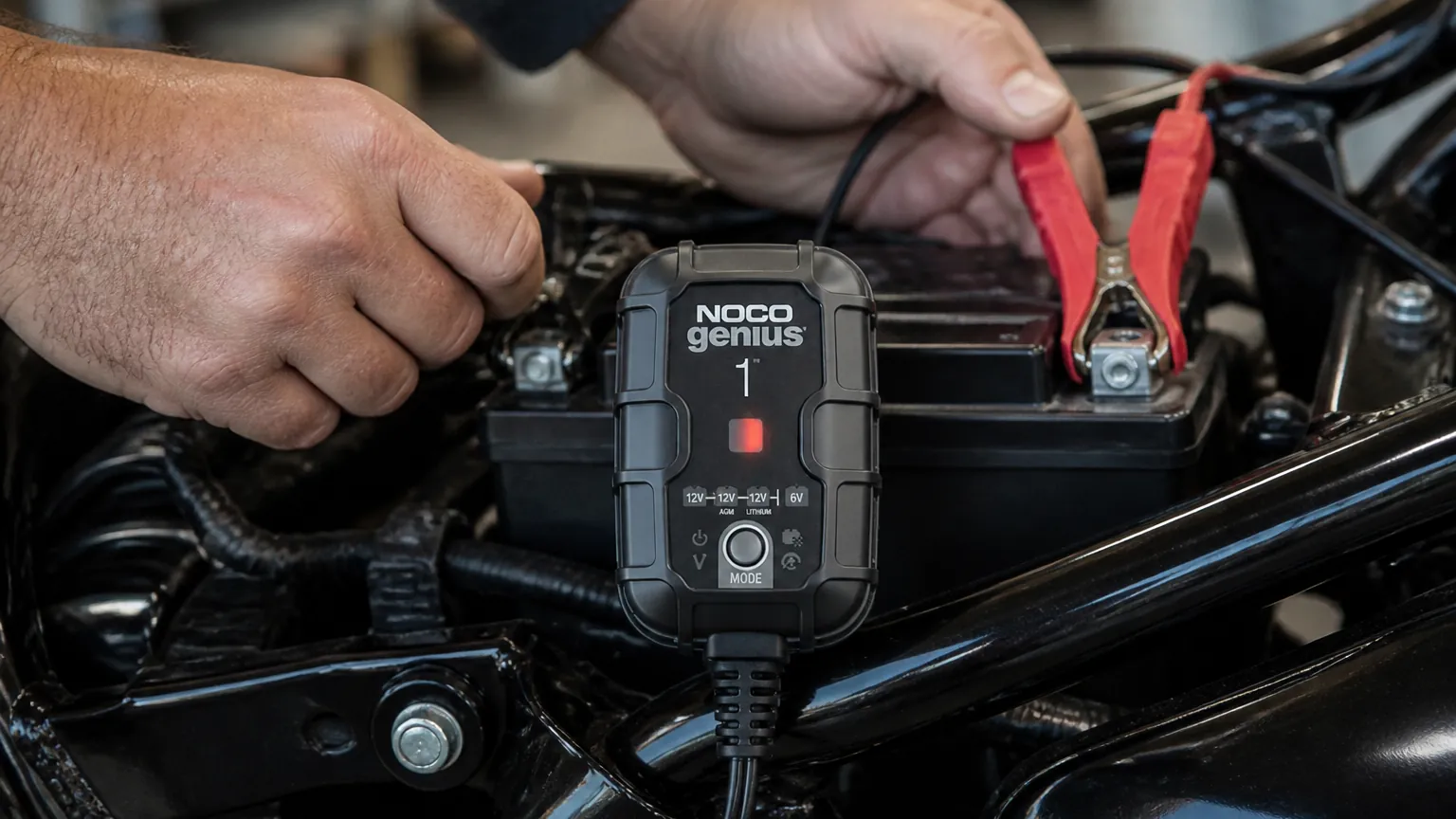
This NOCO Genius1 review looks at the smallest, cheapest model in NOCO's Genius line of smart chargers: a 1-amp unit built to keep 6-volt and 12-volt batteries topped up, revive deeply discharged ones, and sit connected for months without fuss. It's aimed at people with motorcycles, classic cars, lawn equipment, ATVs, boats and other vehicles that sit idle for long stretches, rather than anyone hoping to quickly jump a flat car battery. We haven't tested this charger ourselves. Instead, this review brings together NOCO's own published specifications and what owners report across retailer reviews and owner forums, so you get the maker's claims and the real-world experience side by side.
What you get
The Genius1 is a compact smart charger, maintainer, trickle charger and desulfator in one small black housing. It plugs straight into a wall outlet (there's no separate AC cord) and runs a 110-inch DC cable to either battery clamps or the included eyelet terminals you can bolt directly to a battery. NOCO markets it as the successor to the older G750, saying it's about 35% smaller and delivers over 35% more power. It's designed in the USA, though some listings show country of origin as China, and it comes with a 3-year limited warranty.
| Spec | Detail |
|---|---|
| Output current | 1 Amp DC |
| Output power | 15 W (max) |
| Input voltage | 120–240 VAC, 50–60 Hz |
| Battery voltages | 6V and 12V |
| Battery chemistries | Lead-acid (Wet, Gel, MF, CA, EFB, AGM) and Lithium (LiFePO4) |
| Capacity range | Up to 30 Ah (maintains all sizes) |
| Low-voltage detection | Down to 1V; Force Mode for batteries at zero volts |
| Efficiency | 85% (120VAC) / 83% (230VAC) |
| Housing protection | IP60 |
| Weight | Approx. 0.77 lb (0.35 kg) |
| DC cable length | 110 inches |
| Operating temp | -20°C to +40°C (-4°F to 104°F) |
| Warranty | 3-Year Limited |
The most important thing to understand is how this model differs from its look-alikes. The Genius1 is the entry-level unit at the bottom of the range. Buyers most often confuse it with the near-identical Genius2, which doubles the output to 2 amps, handles batteries up to 40Ah, charges roughly twice as fast, and adds a mounting bracket and Velcro strap the Genius1 lacks. Step up again to the Genius5 or Genius10 and you gain true repair and supply modes the Genius1 doesn't have. There's also a UK/EU variant (the GENIUS1UK) with a different plug and input, so buy the version made for your country.
What owners like
For its intended job, owners are broadly happy. The praise clusters around maintenance, recovery and simplicity.
- Set-and-forget maintenance: Owners of motorcycles, ATVs, lawn equipment, classic cars and seasonal vehicles consistently say it keeps small batteries topped up and can be left connected indefinitely, dropping into a float cycle automatically when full.
- Reviving flat batteries: Several owners report it detects very low batteries and, using Force Mode, brought back ones their other chargers wouldn't even recognize — one revived an ATV battery reading around 1.9 volts.
- Easy to use: Reviewers describe it as mostly plug-and-forget. You pick the battery type and walk away, with LED lights showing charging and conditioning status. The main setup challenge is correctly identifying your battery chemistry.
- Compact and well-built: The small, solid housing is easy to store or leave with a vehicle, and a meaningful share of owners specifically call it well made.
- Reassuring safety features: Owners value the spark-proof and reverse-polarity protection plus overheat and overcharge protection, which make it easier to leave connected unattended.
- Handy eyelet terminals: One reviewer liked being able to unscrew the clamps and use the bolt-on eyelet terminals, making seasonal connect and disconnect quick.
- Long-term loyalty: Some long-time users report owning several units and keeping them plugged in around the clock for years without problems.
Common complaints
The gripes are just as important, and a couple of them are deal-breakers for the wrong buyer.
- Very slow charging (common): At only 1 amp, this is a maintainer, not a fast charger. Owners report it can take a day to several days — occasionally up to two weeks — to recharge a larger or deeply dead battery. It's poorly suited to reviving a big car or truck battery quickly.
- Premature failures (some owners): A recurring pattern across forums and Trustpilot is units that work at first then die, often reported between 2 and 12 months, and sometimes in hot environments. Some owners with several units suspect circuit-board issues, while many others report years of trouble-free use.
- Frustrating warranty claims (some owners): Despite the 3-year warranty, owners describe a painful process — repeated requests for proof of purchase and serial numbers, demands for photos or video, and in some cases being told to cut the cables before a replacement is issued. Some did eventually get replacements, so experiences vary.
- No digital display (some owners): A frequent wish is for a numeric voltage or state-of-charge readout. Owners find the LED-only indicators informative but less detailed than they'd like.
- Plugs straight into the wall (some owners): With no AC cord, the unit plugs directly into the outlet, which some find awkward, and a few feel the DC clamp cable is too short for their setup.
- Occasional charge-complete issues (occasional): A few owners report the light staying on a pulsing red and not switching to fully charged, and one heard boiling noises from a sealed battery and unplugged it — suggesting charge-complete detection isn't flawless on every battery.
Running costs and upkeep
There's little to worry about here. The charger draws a maximum of 15 watts, and once the battery is full it only applies power intermittently in float mode, so day-to-day energy use is minimal. As a worst-case example, 15 watts running continuously is about 0.015 kWh per hour, or roughly 0.36 kWh per day. At about 17 US cents per kWh that's around 6 cents a day at full draw; at about 25p in the UK roughly 9p; and at around 30 Australian cents close to 11 cents. In reality, in maintenance mode the figure is a small fraction of that, so for most owners the running cost is negligible.
There are no consumables and no subscription. Cleaning is just the occasional wipe; keep the terminals and clamps clean and dry. On warranty, NOCO states a 3-year limited ("Hassle-Free") warranty covering defects in materials and workmanship when used per its guidelines, running from the date of original retail purchase (or, with no proof of purchase, from the serial-number date). NOCO will repair or replace at its discretion, the warranty is non-transferable, doesn't cover shipping or return costs, and excludes wear and tear, cosmetic damage, misuse, modification or units with a missing or altered serial number. Keep your receipt — owner reports suggest you'll likely be asked for it. One key safety note from the manual: Force Mode disables the charger's safety features and leaves live power at the connectors, so use it carefully and only when needed. The product also carries a California Prop 65 chemical warning, and the manual includes standard charger warnings about shock, explosion and fire.
How it compares
These are the alternatives owners most often mention alongside the Genius1.
| Charger | How it compares |
|---|---|
| NOCO Genius1 | The smallest, cheapest Genius. Great as a maintainer and for reviving small batteries, but slow to charge and reliability is mixed. No mounting bracket. |
| NOCO Genius2 | The one buyers most often cross-shop. Doubles the output to 2 amps, charges roughly twice as fast, handles up to 40Ah and adds a mounting bracket. The better pick if you ever need to actually charge a car battery, not just maintain it. |
| CTEK (e.g. MXS 5.0) | A frequently named European alternative. Some owners who had NOCO units fail switched to CTEK and report reliable results across all their batteries. |
| Deltran Battery Tender / BatteryMINDer | Long-time users cite these maintainers lasting a decade or more, holding them up as more durable than NOCO units that failed early. |
Owners who gave up on NOCO after repeated failures also mention Victron, Optimate and Bosch chargers as dependable replacements in a similar low-amp class.
Who should buy it, and who should skip it
- You want a maintainer for a motorcycle, classic car, boat, ATV or lawn equipment that sits unused for weeks or months.
- You need something small and simple to leave connected over winter or between uses.
- You occasionally need to coax a small, deeply discharged battery back to life.
- You charge both lead-acid and LiFePO4 lithium batteries and want one unit for both.
- You need to charge a flat car or truck battery quickly — the 1-amp output is far too slow, so get the Genius2 or larger.
- You want a numeric voltage or state-of-charge display rather than LED lights.
- You've been burned by NOCO reliability or warranty service before and want a maker with a longer durability track record.
Our NOCO Genius1 review verdict
As a dedicated maintainer, the Genius1 does the one job it's built for well. Owners of seasonal and rarely used vehicles repeatedly praise it for keeping small batteries topped up, dropping into float safely, and sometimes rescuing batteries other chargers won't even detect. It's compact, easy to use once you've picked the right battery type, and its safety features make it reassuring to leave plugged in. For a bike, mower or classic car battery, it's a sensible, low-running-cost choice.
The caveats are real, though. At 1 amp it is genuinely slow, so if there's any chance you'll need to charge rather than just maintain a battery, spend a little more on the Genius2. Reliability is the bigger question mark: plenty of owners run theirs for years, but a recurring thread of early failures — and a warranty process some describe as a hassle — means this isn't a guaranteed buy-and-forget. If you want proven longevity, CTEK, Deltran or BatteryMINDer are worth a look. Check the current price on Amazon, buy the version made for your country, and keep your receipt in case you need to claim.
As an Amazon Associate we earn from qualifying purchases.
Sources
This review brings together the maker's specifications and what owners report. We have not tested the NOCO Genius1 Battery Charger ourselves. Product details checked November 11, 2026.
Daniel Hart
Editor, Car & Garage · Columbus, Ohio
Daniel edits the Car & Garage section. He writes about the plug-in scanners, dash cams and chargers that help drivers understand their cars and avoid unnecessary repair bills, and he is clear about when a professional mechanic is still the right call.
Keep reading
Portable Tire Inflator: How to Pick the Right Air Pump
Cold weather pulls air out of your tires fast. Here is how to choose a portable inflator that is accurate, convenient, and worth the money.

Best Dash Cam: VIOFO A229 Pro vs Wolfbox G840S
Two popular 4K front-and-rear dash cams go head to head on video quality, parking mode and real running cost, so you can pick the right protection.
NOCO GB40 Review: The Pocket Jump Starter Worth Its Price?
Our NOCO GB40 review weighs up the maker's claims against what owners actually report, so you know if this compact jump starter belongs in your glovebox.
Comments
No comments yet. Share your experience or ask a question.