Portable Tire Inflator: How to Pick the Right Air Pump
Cold weather pulls air out of your tires fast. Here is how to choose a portable inflator that is accurate, convenient, and worth the money.

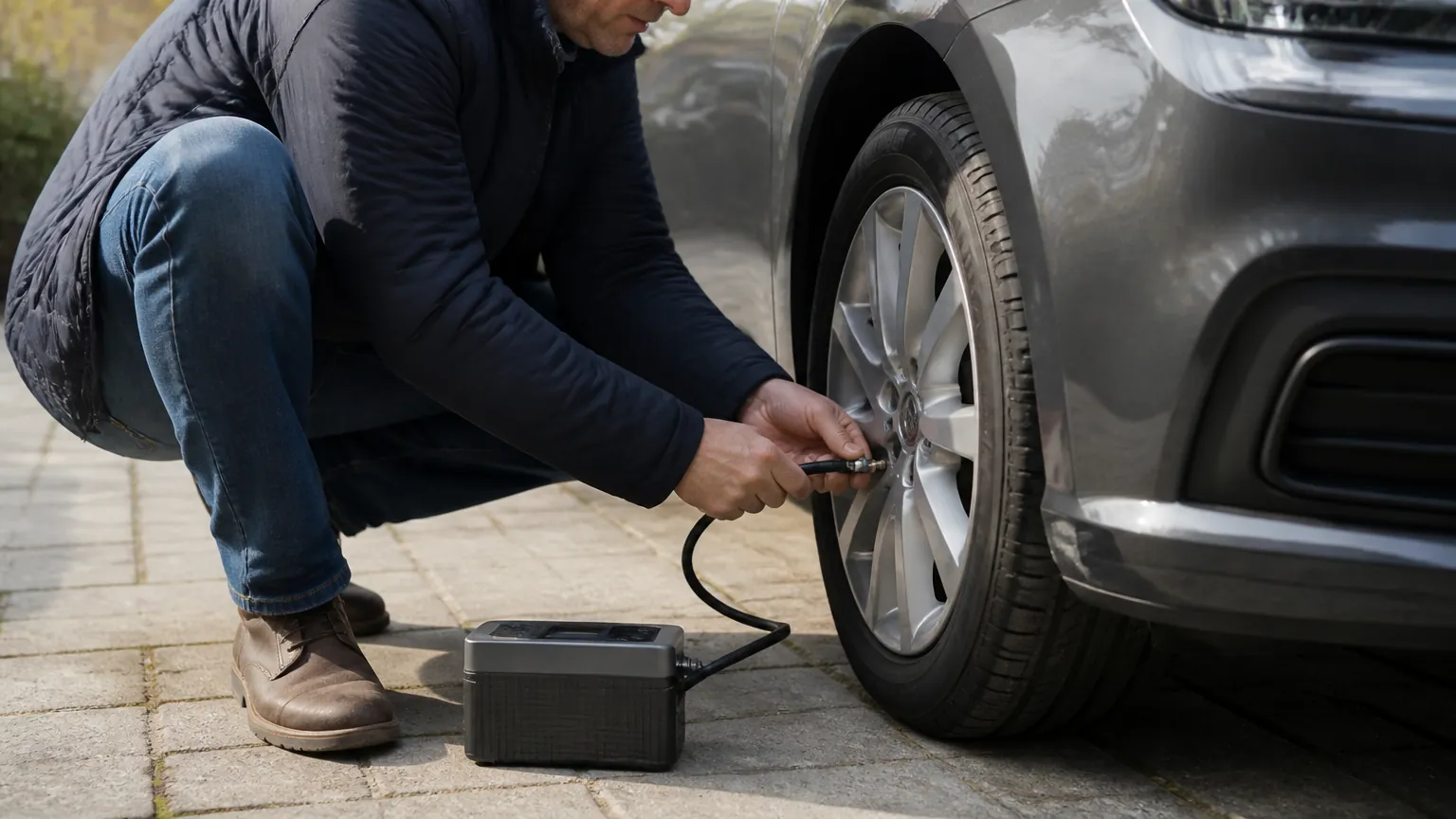
When the temperature drops, your tires lose air whether you notice or not. That is simple physics: cold air takes up less space, so pressure falls. As a rough guide, tire pressure drops by about 1 PSI for every 5.5°C (10°F) the temperature falls. Go from a mild autumn afternoon to a hard winter morning and you can easily be 3 to 4 PSI low across all four tires. That is enough to hurt handling, wear the edges of your tread, and nudge up your fuel use. A portable tire inflator lets you fix that in your own driveway in a few minutes, without hunting for a working air machine at a gas station. This guide explains what the numbers mean, how battery and plug-in models differ, how seriously to take accuracy claims, and when a soft tire is telling you to stop and get help.
What PSI actually means, and the number that matters
PSI stands for pounds per square inch, the most common unit for tire pressure in the US and still widely used in the UK and Australia alongside bar and kPa. For reference, 32 PSI is roughly 2.2 bar or about 220 kPa. Most inflators let you switch units, so you can match whatever your car asks for.
The number you want is not printed on the tire. The figure molded into the sidewall is the maximum pressure the tire can hold, not the recommended pressure for your car. The correct figure lives on a sticker inside the driver's door frame, or sometimes on the fuel filler flap or in the owner's manual. It is usually somewhere between 30 and 36 PSI for ordinary cars, and often higher for loaded vans or when carrying a full passenger load. Set your pressure to that figure, not the sidewall maximum.
Check pressure when the tires are cold, meaning the car has been parked for a few hours or driven less than a mile or two. Driving warms the air inside and temporarily raises the reading, so a "hot" check will fool you into under-inflating.
Why cold weather makes this urgent
Because pressure falls with temperature, tires that were spot-on in October can be noticeably soft by December. Many cars built from the mid-2010s onward have a tire pressure monitoring system (TPMS) that lights up a warning on the dash. In the US, TPMS has been mandatory on new passenger vehicles since 2008; the EU required it on new cars from around 2014, and the UK and Australia followed similar timelines. That warning light is helpful, but it typically triggers only once pressure is already about 25 percent low. By then you have been driving on soft tires for a while. A quick monthly check with your own gauge catches the problem sooner.
Battery vs plug-in: how they really differ
Portable inflators come in three broad types, and the right one depends on where and how often you will use it.
- 12V plug-in (cigarette lighter socket). These draw power from your car's 12-volt outlet, usually pulling around 10 to 15 amps, so roughly 120 to 180 watts. They never run out of charge as long as the engine is running, and they tend to be the cheapest, commonly around $25 to $40. The downsides: a cord that only reaches so far, and you should run the engine to avoid draining the starter battery.
- Cordless battery. These run on a built-in lithium cell or a swappable power-tool battery (the same packs used by brands like DeWalt, Ryobi, or Makita). Battery capacity is often quoted in milliamp-hours or amp-hours; a 2.0Ah 20V pack is typical. Convenient for bikes, sports gear, and tires away from the car, but a single charge may only do a few tires before it needs recharging, and performance drops in the cold. Expect roughly $40 to $100, more for name-brand tool batteries.
- Corded mains (120V/230V) compressors. These plug into a wall socket and are the most powerful, better suited to a garage than a roadside. In the US and Canada they run on 120V; in the UK, Australia, and most of Europe on 230V. These are less "portable" in the everyday sense but worth knowing about if you also inflate larger tires or air tools.
For most people topping up car tires at home, a 12V plug-in or a decent cordless unit is plenty. You do not need a workshop compressor to add a few PSI.
Running cost: smaller than you might fear
Inflators use very little electricity because you run them for only a minute or two per tire. Say a mains inflator draws 150 watts and you run all four tires for a total of 8 minutes. That is 0.15 kW multiplied by 0.133 hours, which is about 0.02 kWh. At roughly 17 US cents per kWh that works out to well under half a cent. In the UK at about 25p per kWh it is still under a penny, and in Australia at around 30 Australian cents per kWh the cost is similarly trivial. Electricity prices vary by country and tariff, but the headline is the same: the power cost of inflating tires is close to nothing. The real cost is the device itself and whether it lasts.
Accuracy: the claim to be skeptical about
This is where cheap inflators disappoint. The built-in gauge on a budget unit can read several PSI off, and manufacturers' accuracy claims are rarely independently verified. Commonly reported figures from product listings are around plus or minus 1 to 3 PSI, but that is the maker's own claim, not something we have measured. A 3 PSI error on a 32 PSI target is nearly 10 percent out, which defeats the point of checking carefully.
The practical fix is cheap: keep a separate, good-quality tire pressure gauge. A standalone pencil or dial gauge costs around $5 to $15, and a digital one around $10 to $25. Use the inflator to add air, then confirm the final pressure with the standalone gauge. If you only trust one number, trust the separate gauge, not the pump's display.
A few other features genuinely help. An auto-shutoff that stops at your set pressure saves you from overfilling. A built-in light is useful for a dark driveway on a winter evening. And a longer hose or a screw-on (rather than press-on) valve connector makes the job far less fiddly, especially on tires with recessed valves.
Comparing the main types
| Type | Typical price (USD) | Power draw | Best for | Main limitation |
|---|---|---|---|---|
| 12V plug-in | $25 to $40 | ~120 to 180 W from car socket | Regular car top-ups at home or roadside | Cord reach; run engine to protect battery |
| Cordless (built-in battery) | $40 to $80 | Internal lithium cell | Bikes, sports gear, quick tire top-ups | Limited runtime per charge; weaker in cold |
| Cordless (tool battery) | $50 to $100+ | Swappable 18V/20V pack | People who already own that tool system | Battery cost if bought separately |
| Mains compressor | $60 to $150+ | ~150 W and up at 120V/230V | Garage use, larger tires, air tools | Needs a wall socket; least portable |
Using one safely, and when to stop
Inflating a tire is low-risk, but a few habits are worth keeping.
- Do not exceed the recommended pressure on the door-frame sticker. Overinflation reduces grip and wears the center of the tread.
- Let the inflator cool between tires if the motor gets hot. Many budget units are rated for short runtimes and can overheat if run continuously.
- Keep fingers and loose clothing away from any moving fan, and keep children clear while the pump is running.
- With a 12V plug-in, running the engine avoids flattening your starter battery, particularly in cold weather when batteries are already working harder.
Now the important part. A portable inflator is for routine top-ups, not for fixing a problem tire. If a tire keeps going down over days or weeks, something is wrong, and reinflating it repeatedly only hides a leak. If you find a nail or screw in the tread, do not pull it out; have it inspected. Stop and get professional help if you notice any of the following: a tire that is visibly flat or nearly so, a bulge or blister in the sidewall, a cut you can see cords through, or a tire that loses significant pressure within a day. Driving on a badly under-inflated or damaged tire can cause it to overheat and fail at speed, which is dangerous. A tire shop can tell you quickly whether it is a simple repair or a replacement.
In the UK, under-inflated or damaged tires can also cost you at the annual MOT test, and worn or unsafe tires are an offense. Australia's state-based roadworthy or registration inspections take a similar view, and in the US, state inspection rules vary but a tire in poor condition is still a safety risk regardless of local law. Keeping pressure right is the cheapest maintenance you can do.
If you are kitting out your car for winter generally, it is worth thinking about what else earns its place in the glovebox. Our guide to the best dash cam options covers another gadget that pays off in bad weather. And if you are weighing up where household energy really goes, our breakdowns of whether smart thermostats cut heating bills and what an air fryer versus an oven really costs to run use the same honest, show-the-sum approach.
The short version
- Set tires to the pressure on the door-frame sticker, not the maximum printed on the sidewall, and check them cold.
- Cold weather lowers pressure by about 1 PSI per 5.5°C (10°F), so top up as winter sets in.
- A 12V plug-in inflator suits most home top-ups; cordless adds convenience; a mains compressor is for garage use.
- Treat the built-in gauge with caution and confirm the final reading with a separate pressure gauge.
- Use an inflator for routine top-ups only; a tire that keeps deflating, bulges, or has visible damage means stop and get it checked.
Daniel Hart
Editor, Car & Garage · Columbus, Ohio
Daniel edits the Car & Garage section. He writes about the plug-in scanners, dash cams and chargers that help drivers understand their cars and avoid unnecessary repair bills, and he is clear about when a professional mechanic is still the right call.
Keep reading
Best Dash Cam: VIOFO A229 Pro vs Wolfbox G840S
Two popular 4K front-and-rear dash cams go head to head on video quality, parking mode and real running cost, so you can pick the right protection.
NOCO Genius1 Review: A Great Maintainer, A Slow Charger
An honest look at NOCO's smallest smart charger: brilliant for keeping seasonal batteries topped up, but far too slow to rescue a dead car battery fast.
NOCO GB40 Review: The Pocket Jump Starter Worth Its Price?
Our NOCO GB40 review weighs up the maker's claims against what owners actually report, so you know if this compact jump starter belongs in your glovebox.
Comments
No comments yet. Share your experience or ask a question.