Slow Cooker vs Instant Pot: Running Costs Compared
Which one-pot appliance actually costs less to run for your batch cooking? We break down the watts, the hours, and the real numbers in plain money.

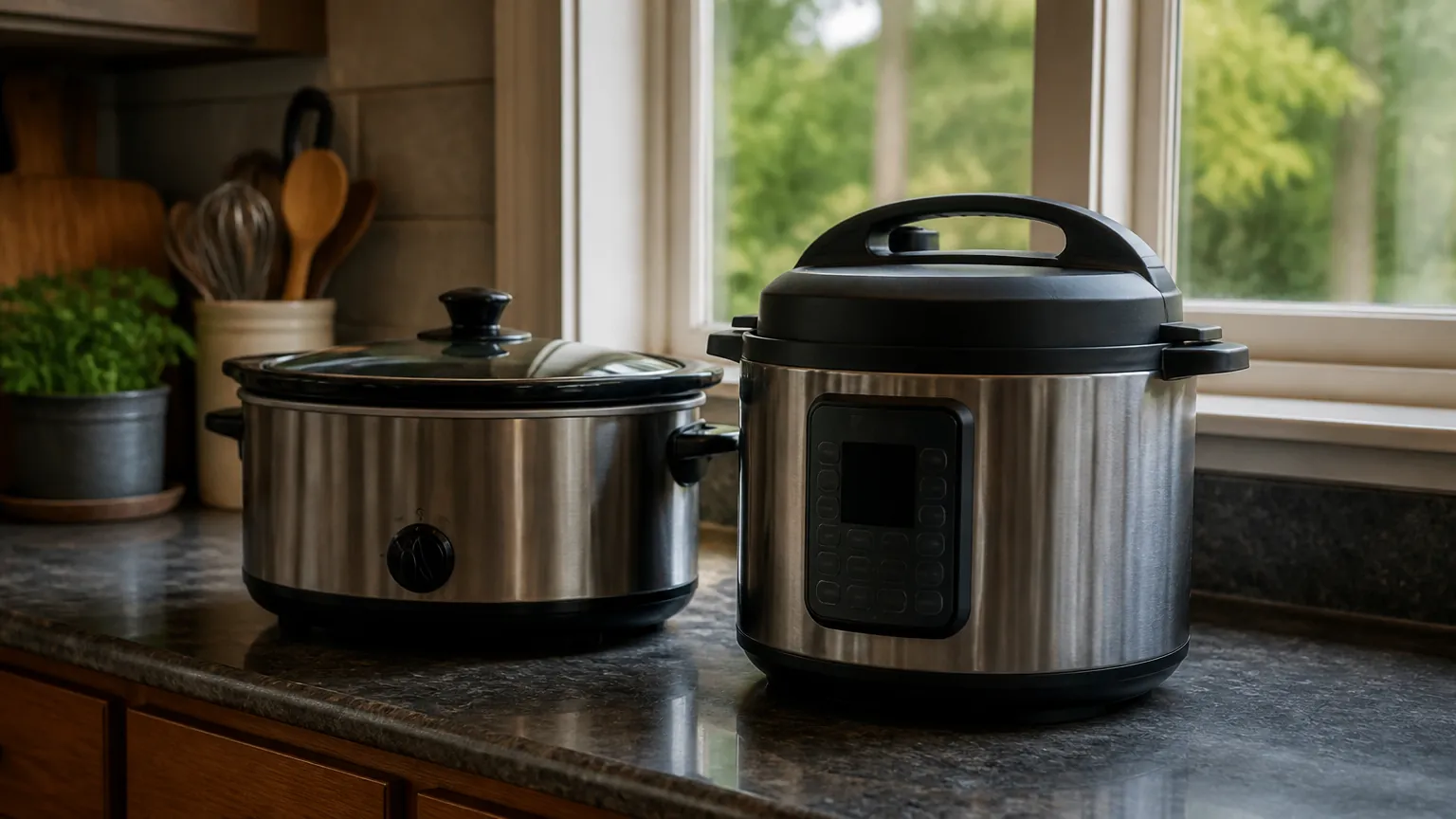
When the weather turns cold, a big pot of stew or a batch of beans starts to look very appealing, and the two appliances most people reach for are the slow cooker and the electric pressure cooker, usually called by the brand name Instant Pot. The question of slow cooker vs Instant Pot comes up every autumn, and most of the advice online skips the part you actually care about: what does each one cost to run? The honest answer is that both are cheap compared with heating your oven, but they get there in very different ways. One sips a little power over many hours; the other draws a lot for a short burst. Below we work through the watts, the cooking times, and the real money, so you can pick the tool that suits your kitchen and your bills.
How each appliance uses power
A slow cooker is a simple device: a ceramic pot sitting inside a heated housing. It warms food gently, usually to a simmer somewhere around 90°C to 100°C (195°F to 210°F), and holds it there for hours. Because the heat is low and steady, the power draw is modest. Most slow cookers pull somewhere between 150 and 300 watts once they are up to temperature, with larger models and the "high" setting at the upper end.
An Instant Pot is a sealed electric pressure cooker. It uses a powerful heating element to bring the contents to pressure quickly, then cooks at a higher effective temperature, around 115°C to 120°C (239°F to 250°F), because the sealed pot raises the boiling point. That heating element is strong, commonly rated between 700 and 1,200 watts. The key point is that this high draw is not constant. The pot works hard to reach pressure, then cycles the element on and off to maintain it, so the average power over a cooking session is much lower than the peak.
So you are comparing a low wattage over a long time against a high wattage over a short time. That is exactly the kind of trade-off where the running cost is not obvious until you do the sum.
A note on voltage and plugs
Mains voltage differs by country, and it affects how these appliances are built rather than how much energy they use. The US and Canada run on about 120 volts, so a high-wattage pressure cooker there draws more amps and heats a little more slowly. The UK, Australia and most of Europe run on about 230 to 240 volts, which handles high-wattage appliances comfortably. Either way, the energy used to cook the same food is roughly the same, because a kilowatt-hour is a kilowatt-hour regardless of voltage. Always use the plug and cord supplied for your region, and don't run either appliance through a flimsy travel adapter.
Working out the running cost
To turn watts into money you need two things: how many kilowatt-hours (kWh) a dish uses, and your electricity rate. A kilowatt-hour is 1,000 watts running for one hour. To keep the examples fair, electricity prices vary by country, so we will use three sample rates throughout: roughly 17 US cents per kWh in the US, about 25p in the UK, and around 30 Australian cents.
Let's cook the same dish two ways: a beef stew that needs 8 hours on low in a slow cooker, or about 35 minutes at pressure in an Instant Pot (plus time to come up to and release pressure).
Slow cooker example
Say your slow cooker averages 200 watts, which is 0.2 kW. Over 8 hours that is:
- 0.2 kW × 8 hours = 1.6 kWh
- US: 1.6 × $0.17 = about 27 cents
- UK: 1.6 × £0.25 = about 40p
- Australia: 1.6 × A$0.30 = about 48 cents
Instant Pot example
The pressure cooker draws more, but for far less time. A realistic average over a whole session, including heating up and holding pressure, is around 0.4 to 0.5 kWh for a stew of this size. Using 0.45 kWh:
- US: 0.45 × $0.17 = about 8 cents
- UK: 0.45 × £0.25 = about 11p
- Australia: 0.45 × A$0.30 = about 14 cents
On energy alone, the Instant Pot wins this round, using roughly a third of the slow cooker's power for the same stew. That is because less total heat escapes over 35 minutes than over 8 hours. These figures are estimates based on typical wattages, not lab measurements, so treat them as ballpark rather than exact.
The numbers side by side
Here is a fuller comparison for a typical batch-cooking session. Pressure-cook times exclude the extra 10 to 20 minutes a pot takes to reach pressure and release it, which we have folded into the energy estimates.
| Factor | Slow cooker | Instant Pot (pressure) |
|---|---|---|
| Typical power draw | 150–300 W | 700–1,200 W peak, cycling |
| Time for a beef stew | 6–10 hours (low) | 30–40 min at pressure |
| Energy per stew | around 1.6 kWh | around 0.45 kWh |
| Cost (US, 17c/kWh) | about 27 cents | about 8 cents |
| Cost (UK, 25p/kWh) | about 40p | about 11p |
| Cost (AU, 30c/kWh) | about 48 cents | about 14 cents |
| Hands-on attention | Low, long wait | Low, quick but hotter |
| Typical purchase price | around $25 to $70 | around $70 to $150 |
Over a year, the gap is real but small in absolute terms. If you batch-cook twice a week, the slow cooker might cost you around $28 a year in the US to run for those meals, against roughly $8 for the pressure cooker. In the UK that is about £42 against £11; in Australia about A$50 against A$14. Worth knowing, but not life-changing on its own. The purchase price difference may outweigh the running-cost saving for a year or two.
Cost isn't the whole story
Running cost is only one part of choosing between these two. A few practical differences matter just as much.
- Timing. A slow cooker suits a "set it in the morning, eat it at night" routine. A pressure cooker suits "I forgot to plan dinner and need it in 45 minutes." If you are often out all day, the slow cooker's long, unattended cook is genuinely useful.
- Texture. Long, low cooking breaks down tough cuts beautifully and lets flavors mingle. Pressure cooking is faster but can give a slightly different result; many people find both perfectly good, just not identical.
- Versatility. Most Instant Pots also sauté, steam and keep warm, and many include a slow-cook setting, though it is commonly reported to run cooler than a dedicated slow cooker. One appliance doing several jobs can save counter space.
- Keep-warm. Leaving either on "keep warm" for hours adds to the running cost. If you tend to do this, your real bill will be higher than the single-cook figures above.
If your main goal is simply spending less to cook, it is worth remembering that the appliance matters less than the habit. Batch cooking once and reheating portions beats cooking from scratch every night in either device. For more on how appliance choices add up, our guide to air fryer vs oven running costs covers the same thinking for roasting and baking, and whether smart plugs actually save money is useful if you want to measure your own appliances.
Safety and good habits
Both appliances are safe when used sensibly, but they deserve respect. Pressure cookers hold hot steam under pressure, so follow the manual for releasing it and keep your face and hands clear of the valve. Never force the lid. Modern electric models have safety locks, but an older or damaged seal can let steam escape where you don't expect it, so check the gasket for cracks.
For slow cookers, the ceramic pot can crack if moved from hot to cold quickly, so don't set a hot pot on a cold or wet surface. Place either appliance on a heat-resistant worktop, away from the edge and out of reach of children, since the outer housing gets hot. Don't run either on a damaged cord or a daisy-chain of extension leads. If you want to track exactly what yours draws, an inexpensive plug-in energy meter will show the real kWh for your own recipes, which is more accurate than any estimate here. While you are rethinking your kitchen gadgets, you might also find our look at temperature-control electric kettles useful for everyday energy savings.
The short version
- Per meal, the Instant Pot usually uses less energy, roughly a third of a slow cooker's for the same stew, because it cooks for far less time.
- The running-cost gap is real but modest: for a stew, around 8 cents vs 27 cents in the US, 11p vs 40p in the UK, 14 vs 48 cents in Australia.
- Choose a slow cooker for all-day, unattended cooking; choose a pressure cooker for speed and multi-function use.
- Leaving either on "keep warm" for hours quietly adds to the bill, so switch it off once you have served.
- Electricity rates differ by country, so plug your own rate into kWh × price, and a plug-in meter will give you the real figure for your recipes.
Emma Clarke
Home & Kitchen writer · Melbourne
Emma covers home and kitchen gadgets, from smart plugs to air fryers. She focuses on what things really cost to buy and run at home, and on the features that matter once the novelty wears off.
Keep reading
Are Electric Kettles With Temperature Control Worth It?
Variable-temperature kettles promise better tea and coffee, but do they earn their keep? Here's what the extra money buys, and when a plain kettle is fine.
Air Fryer vs Oven: What Each Really Costs to Run
Air fryers get praised for saving money, but is that true for every meal? Here are the watts, the cooking times, and the cost per dish worked out in plain numbers.
Wireless CarPlay Adapters: Are They Worth Buying?
A wireless CarPlay adapter frees you from the cable, but there are real trade-offs in lag, heat and battery drain. Here is what to expect before you buy.
Comments
No comments yet. Share your experience or ask a question.