Heated Blanket Cost per Hour vs a Space Heater
We work out what a heated throw really costs per hour, compare it to running a space heater, and show when heating just yourself saves real money.

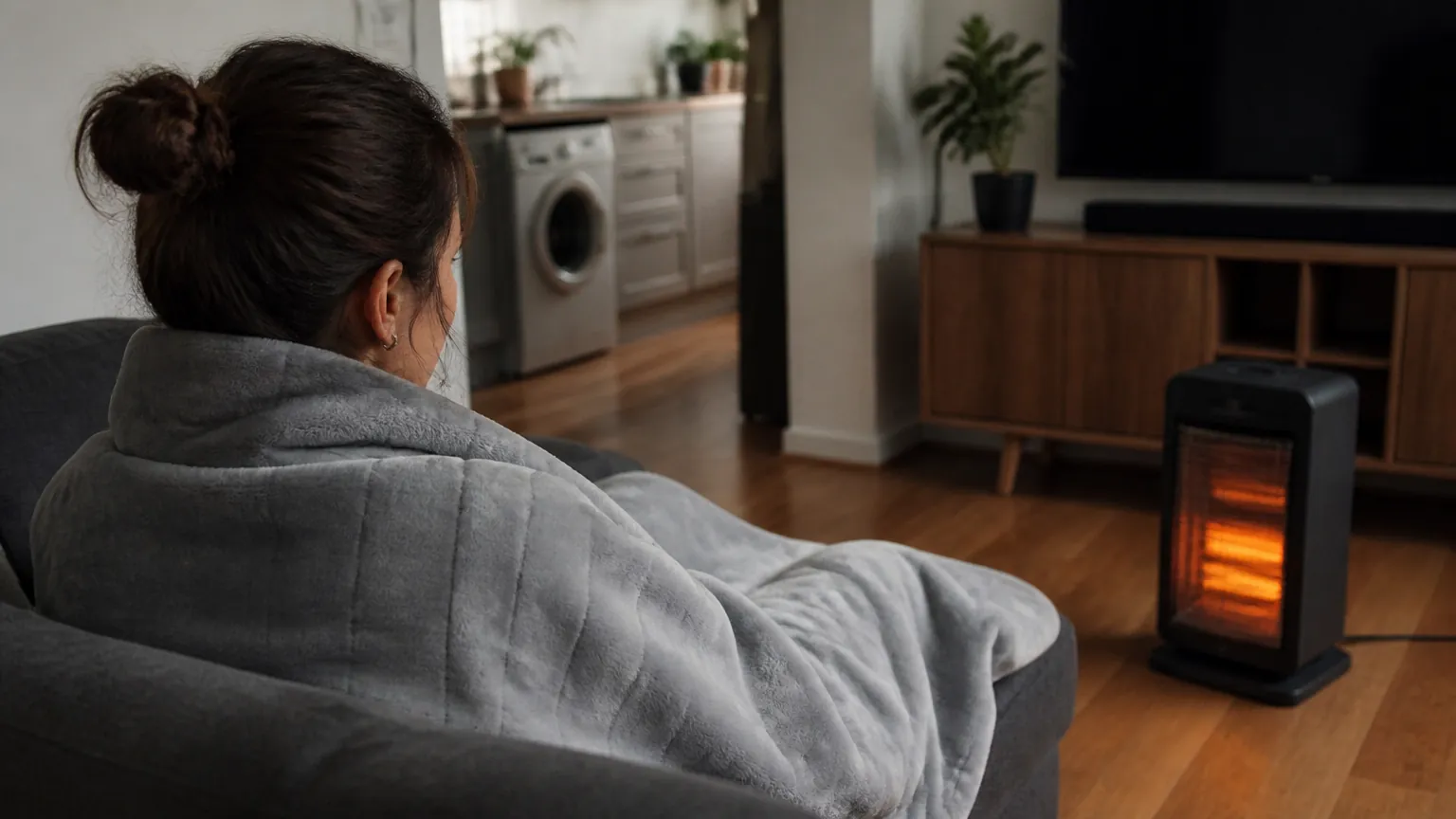
When the temperature drops and the energy bill lands on the same day, a lot of people start wondering whether they really need to heat the whole room. This is where the idea of "heating the human" comes in: instead of warming all the air in a space, you warm the person. A heated throw over your lap uses a tiny fraction of the power a space heater does, and the heated blanket cost over an evening can be surprisingly small. But it is not always the right answer, and the honest picture depends on how many people you are keeping warm and how long you sit still. Let's work through the numbers in plain terms so you can decide for your own home.
How much power each one actually uses
The gap between these two devices is wide, and it comes down to wattage. A device's running cost is simply its power draw multiplied by how long it runs and by your electricity price.
A typical electric heated throw or lap blanket draws somewhere around 50 to 120 watts on its highest setting, and much less once it reaches temperature and starts cycling on and off. Larger electric underblankets or overblankets for a double bed are often in the 60 to 150 watt range. These are low-power devices by design.
A space heater is a different animal. Most portable electric heaters sold in the US, the UK and Australia are built to the maximum a standard wall socket can comfortably supply, which is commonly reported as around 1,500 watts in North America (120 volts) and up to roughly 2,000 to 3,000 watts in the UK and Australia (230 to 240 volts). So a space heater can easily draw 15 to 40 times more power than a heated throw.
That single fact is why heating the human is cheaper. You are powering a small heating element touching your body instead of trying to raise the temperature of an entire room full of air, walls and furniture.
Mains voltage and plugs differ by country
If you buy a heated blanket while traveling or online from overseas, check the voltage. A 120-volt US blanket will not work correctly on 230 to 240-volt UK or Australian mains, and the reverse is also true. Plug shapes differ too: North America uses flat-pin plugs, the UK uses three rectangular pins, and Australia uses angled flat pins. Use a device rated for your own country's supply rather than a travel adapter for anything that heats.
The running cost, worked out
Here is the part that matters. To keep the math simple, we will use an example electricity rate of 17 US cents per kilowatt-hour (kWh). Prices vary by country and plan, so adjust for yours: it is roughly 25p per kWh in the UK and around 30 Australian cents per kWh at the time of writing.
The formula is: watts ÷ 1,000 × hours × price per kWh.
- Heated throw at 100 watts, 4 hours: 0.1 kW × 4 h = 0.4 kWh. At 17 cents that is about 7 cents for the evening. In the UK (25p) around 10p; in Australia (30c) around 12 cents.
- Heated throw run for 1 hour: 0.1 kWh, or roughly 1.7 cents per hour at the US rate.
- Space heater at 1,500 watts, 4 hours: 1.5 kW × 4 h = 6 kWh. At 17 cents that is about $1.02. At the UK rate that is around £1.50; at the Australian rate around A$1.80.
- Space heater at 2,000 watts (common in UK/AU), 4 hours: 8 kWh, about $1.36 at the US rate, or roughly £2 in the UK.
In other words, running a heated throw for an evening costs roughly the price of a single email's worth of electricity, while a space heater over the same period costs about the same as a cheap snack. Over a cold month, that difference adds up.
| Device | Typical power | Cost per hour (US, 17c/kWh) | Cost per 4 hours (US) | Per 4 hours (UK 25p / AU 30c) |
|---|---|---|---|---|
| Heated throw (lap blanket) | 100 W | ~1.7 cents | ~7 cents | ~10p / ~12c |
| Electric underblanket (bed) | 120 W | ~2 cents | ~8 cents | ~12p / ~14c |
| Small space heater | 1,000 W | ~17 cents | ~68 cents | ~£1 / ~A$1.20 |
| Standard space heater (US) | 1,500 W | ~26 cents | ~$1.02 | ~£1.50 / ~A$1.80 |
| Larger heater (UK/AU) | 2,000 W | ~34 cents | ~$1.36 | ~£2 / ~A$2.40 |
These are approximate figures to show the scale of the difference, not measured results. Real costs depend on the exact model, your tariff, and how often the thermostat cycles the heater off once a room is warm. A heater in a well-insulated small room that quickly reaches temperature will cost less than the full-power figure above; one fighting a draughty space may run flat out and cost more.
When the blanket genuinely wins
The heated throw is the clear money-saver in a specific and common situation: one or two people sitting still in one spot for a stretch of time. If you are reading, watching television, working at a desk or dozing on the sofa, a throw keeps you warm for a fraction of a cent to a couple of cents an hour, and you simply do not need to heat the air around you.
It also wins overnight. An electric underblanket warmed for 30 minutes before bed and then switched off, or left on a low setting designed for all-night use, costs very little and lets you turn the bedroom thermostat down. For more on warming yourself rather than the room, our guide to heated gloves and socks and how rechargeable warmth works covers the same logic for hands and feet.
The blanket loses its edge when:
- Several people need warmth at once in the same room. Four throws drawing 100 watts each is 400 watts, and at that point a thermostat-controlled heater that warms shared air may be more sensible and more comfortable.
- You need to move around to cook, clean or do chores. A throw only warms you while you are wrapped in it.
- The room is genuinely cold enough to be a health risk, or you have pipes that could freeze. A throw does not protect the building; a heater does.
Comfort, safety and the honest caveats
A heated throw does not dry damp air or stop your nose feeling cold, and some people find the warmth less satisfying than a warm room. That is a real trade-off, not a fault. If you decide you do want to heat the space, it is worth understanding what heaters actually cost to run and whether "eco" branding changes anything, which we cover in electric space heater costs and whether eco models are worth it and in our look at a cool-and-heat tower combo.
Safety basics worth following
- Choose a blanket with a timer and automatic shut-off, and never fold or bunch an electric blanket while it is switched on, as this can cause hot spots.
- Check the cord and controller for damage before each season. Replace an electric blanket that is frayed, scorched or more than about ten years old rather than repairing it.
- Look for a recognized safety mark: UL or ETL in North America, UKCA or the kite mark in the UK, and the regulatory compliance mark in Australia.
- Do not use an electric blanket on anyone who cannot feel heat or move away from it easily without supervision, and avoid using one together with a hot water bottle.
- For space heaters, keep at least a meter (about three feet) clear of curtains and bedding, plug directly into a wall socket rather than an extension lead, and never leave one running unattended or overnight.
Putting it in context with other appliances
Low-power, targeted heating is the same principle that makes some kitchen appliances cheaper than others: it is usually cheaper to heat a small, enclosed space than a large one. If you enjoy these running-cost comparisons, we use the same approach in air fryer vs oven running costs and in slow cooker vs Instant Pot costs. The lesson that carries across all of them is simple: match the size of the heat to the size of the job. A heated throw is the smallest possible job, which is exactly why it is so cheap.
None of this means a space heater is a mistake. If you genuinely need a warm room, a heater that reaches temperature and then idles on its thermostat is doing a job the blanket cannot. The point is to be deliberate: reach for the throw first when it is just you on the sofa, and bring the heater in when the room itself needs to be warm.
The short version
- A heated throw draws around 50 to 120 watts; a space heater draws roughly 1,500 watts (US) up to 2,000 to 3,000 watts (UK/AU), so the blanket uses a tiny fraction of the power.
- At 17 US cents per kWh, a 100-watt throw costs about 1.7 cents an hour; a 1,500-watt heater costs about 26 cents an hour. Adjust for your rate (about 25p UK, 30c AU).
- The blanket wins when one or two people sit still; the heater wins for several people, moving around, or protecting a cold room.
- Use a safety-marked blanket with auto shut-off, never bunch it up, and replace old or damaged units.
- Match the heat to the job: throw first for one person, heater when the room itself needs warming.
Emma Clarke
Home & Kitchen writer · Melbourne
Emma covers home and kitchen gadgets, from smart plugs to air fryers. She focuses on what things really cost to buy and run at home, and on the features that matter once the novelty wears off.
Keep reading
Replacement Battery Guide: Repair or Replace Your Device?
A fading phone, drill or doorbell doesn't always mean buying new. Here's how to work out when a fresh battery pays off and when it quietly doesn't.
Ring Video Doorbell Review: Battery 2K Plus, Honestly Judged
The Ring Battery Doorbell 2K Plus brings sharper square video and a swappable battery, but owners say the real cost is the subscription you need for saved footage.
Thermostatic Radiator Valve Zoning: Are the Savings Real?
Smart radiator valves promise room-by-room heating control and lower bills, but the install cost adds up fast. Here is what the numbers really look like.
Comments
No comments yet. Share your experience or ask a question.